PRP Physio logo

Shoulder Pain Physiotherapy Brisbane

Shoulder Pain Rehabilitation

Shoulder pain is incredibly frustrating, I get it, I’ve had a few minor episodes of shoulder pain and it isn't fun, let alone suffering a shoulder injury like a dislocation or a labral tear. Research suggests that up to 67% of people suffer shoulder pain in their lifetime and it doesn’t seem to get less common as we get older. People older than 50 most commonly report episodes of shoulder pain. So why do so many people get shoulder injuries? Is it because we use it so much, maybe because it’s such a mobile joint, or are we unlucky? I think it’s a combo of the first two, with a hint of number three on occasions.

Because the shoulder is required to perform movements with such a variety and such a large range of motion, we need to have a shallower joint socket with more of an active stability system aka the rotator cuff. The rotator cuff works to dynamically stabilise the humerus within the shoulder joint through movement. What happens though if our rotator cuff gets a little weak or a little under-used, or if we try to do a little too much too quickly? This is often where we run into trouble. Acute injuries such as a dislocation or rotator cuff tears can occur with more one-off acute traumas such as a traction force on the arm, falling onto an outstretched arm, or catching or lifting a heavy object. Shoulders are incredibly mobile and, on occasions, unstable structures in the right positions and under the right load can cause big problems. Keep your shoulder strong and keep everything around it mobile and you’ll do your best to keep a healthy set of shoulders.

Shoulder pain can be incredibly diverse ranging from acute to chronic rotator cuff tears, to AC joint sprains and shoulder dislocations requiring surgery. As a physio, the shoulder is always keeping me on my toes with what could go on. Sometimes shoulder pain isn’t even caused by the shoulder, on occasions, it’s caused by the cervical or thoracic spine. All I know is it takes time to determine an appropriate diagnosis and treatment pathway.

What is the anatomy of the shoulder?

The shoulder joint is one of the more complex anatomical structures, particularly when looking at it from a functional perspective. The joint is a ball and socket joint, with the humerus sitting within the glenohumeral joint. It is the articulation between the scapula and the humerus. The head of the humerus is significantly larger than the glenoid fossa which it sits in, this is what enables it to have such a wide range of movement.

A large range of ligaments supports the joint whose role is to help stabilise the shoulder. The main supporting ligaments are the glenohumeral ligaments, and the coracohumeral, transverse humeral, and coracoacromial ligaments.

Between the tendons overlying the shoulder joint and the underlying structures are bursae, these are small synovial fluid-filled sacs which aim to reduce friction. There are two within the shoulder joint, the subacromial bursa, and the subscapular bursa.

The rotator cuff muscles attach onto varying areas surrounding the shoulder joint to provide active support and stability to the shoulder joint through different functional activities and movements. The muscle group works together as a group rather than as singular muscles like the quadriceps do to extend the knee. Think of the rotator cuff more like an orchestra playing as one large group rather than just singular instruments playing on their own.

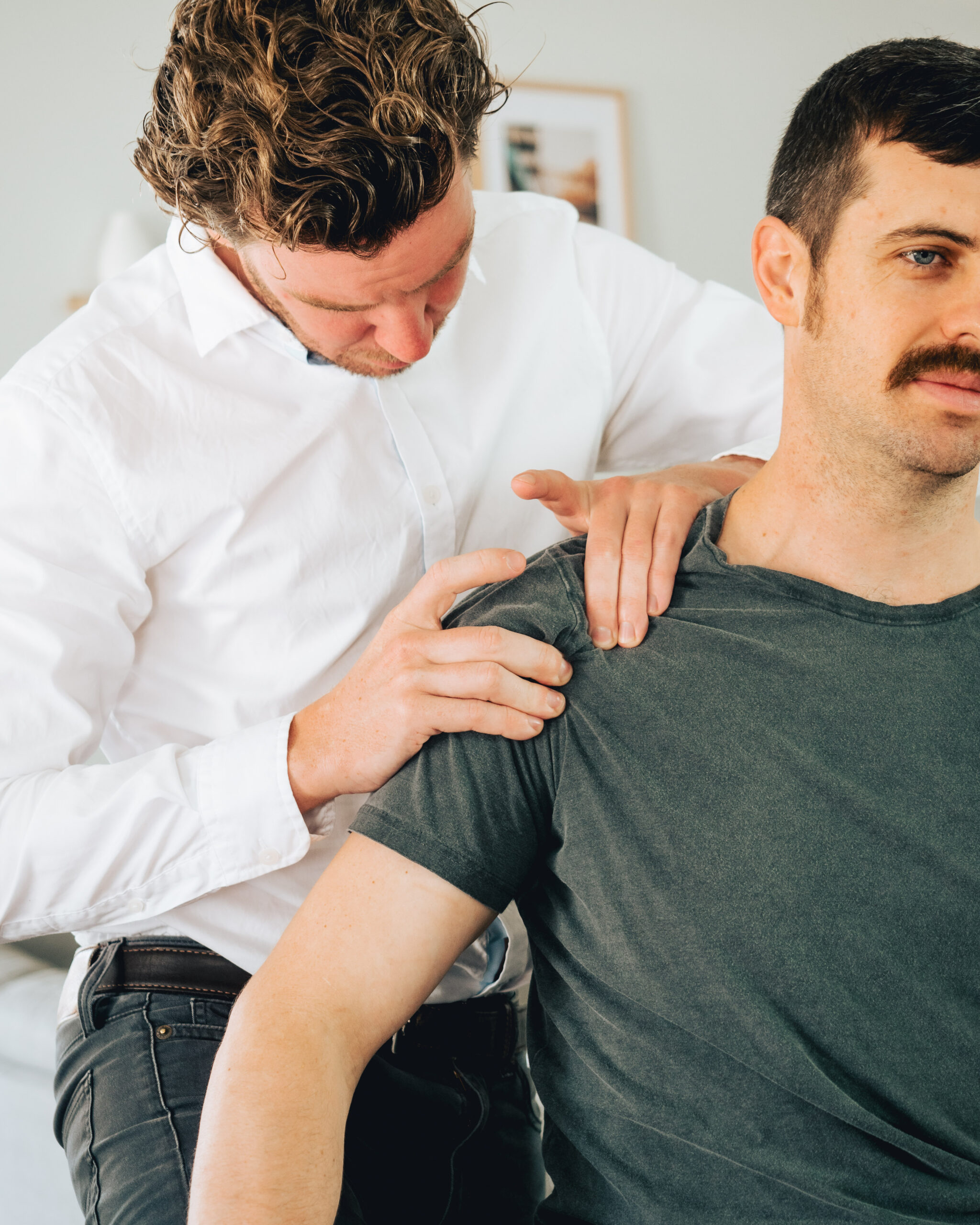
Physiotherapist assessing a client's shoulder rotation
Physiotherapist assessing the movement of a client's shoulder blade

Shoulder Pain Subjective Assessment

Shoulder pain is quite complex, there are a lot of factors that can feed into the onset of symptoms ranging from the thoracic or cervical spine, the scapula (shoulder blade), a range of acute injuries ranging from contact injuries to traction injuries. Before I even know where to begin with objectively assessing shoulder pain we really have to delve into the depths of the history of your shoulder pain.

What Happened?

As with pretty much everything else, the first thing I want to know is how did your concern start. Was there a mechanism of injury where something happened that caused your symptoms, or did they gradually start coming on over a few weeks or months, or maybe you built a deck and now it’s really sore? Whatever you can find out about happened, or sometimes didn’t happen. I want to know all about it. Understanding how your pain came on will help me rule in and rule out potential differential diagnoses.

How does it behave?

For a shoulder, I also like to have a good in-depth understanding of the pain, how it feels, what aggravates it and what makes it feel better, and how the pain behaves throughout the day and at night. I find pain descriptions such as whether the pain feels achy, sharp, shooting, or grabbing, as well as whether it sits on the surface or whether it feels deeper within the shoulder joint. Aggravating factors can vary wildly between people and I’ve certainly heard some interesting ones in my time, but they give me a lot of hints as to what may be causing your symptoms. Night pain is almost a dead giveaway for some cases of shoulder bursitis. I find if you have a certain set of symptoms coupled with pain lying on the shoulder at night; you have a significant chance of getting a positive result from injection therapies.

Any Strange Sensations?

Some of the easier questions to answer include whether you have any pins and needles or numbness, whether you have a previous history of neck injuries or pain. The only outlier important question is whether you have any sensations of looseness, giving way, instability, clicking, or catching sensations. These might indicate more significant structural concerns within the shoulder following an injury such as falling onto an outstretched arm.

Injury History

The biggest predictor for injuries is always if you have had a previous injury to that area before. If you have had a previous episode of shoulder pain, or a previous acute injury, I’ll want to know all about it. As much detail as you can give including any details about whether it felt the same or different to this episode, if you had treatment and if you did what happened and was it successful. The more detail, the better!

Shoulder Pain Objective Assessment

Objective assessments are a great chance to get hands on with some assessments and try to perform some functional changes to the shoulder to try and get some quick wins and fast improvements. The downside of shoulder assessments is that the so called "special tests" really aren't all the special at all. They aren't good at truly differentiating structures, simply because one, everything is too close to each other, and two, everything does a little bit of everything in a sense.

Range of Motion

Range of motion is where we start and we are assessing for the freedom of movement and for any pain produced throughout the movement. All I am looking for with these movements is do you feel any pain or do you feel any restriction, once you hit that point there are two questions – 1 – can you go through it and what happens if you do, and 2 – if that’s as far as you can go what stops you going further. I like for clients to describe what they feel throughout the movement, for example, an often reported sensation is an increase in pain between about 70deg and 100deg when you take your arm straight out the side, and then it dissipates as they go higher. This is quite a common finding among a few shoulder pain presentations.

Neck and Back

Next, I will often deviate away from the shoulder and assess the neck and the thoracic spine for any potential causes of restriction. The thoracic spine is vital for good shoulder health, without adequate extension or rotation you will see adaptations occurring at the shoulder joint to make up for it. Consider that not too many movements you actually do just involve the shoulder joint, want to reach up to a high cupboard? You better hope that you have good thoracic extension, otherwise you might need to ask your shoulder to do a bit more work. The neck is important to clear, it’s not an uncommon cause of shoulder symptoms, and if you have any neural symptoms such as pins and needles or numbness any good physio should clear it. Assessing the range of motion of the cervical spine but then moving on to assess for stiffness and tenderness to palpation to the facet joints. If I’m suspecting involvement in the thoracic spine, I’ll also perform palpation of the spinal segments there assessing for tenderness or stiffness as well.

Special Tests

Special tests of the shoulder to assess for specific structures, only that these tests aren’t all that special after all. These tests were designed so that I could rule in or rule out certain structures with a specific diagnostic test with the aim of isolating that structure. Unfortunately, that’s not really how it works and they fall well short of the mark of being specific to certain structures and more of an “all-round test” which really doesn’t help us all that much. I may use a specific test here and there, but more often than not, I tend not to utilise them because of their poor clinical utility.

Other specific tests I often perform could include an assessment of shoulder instability. I often perform this after an acute injury and I am assessing to see whether there is increased play at the shoulder joint either in the movement going forwards, backwards, or downwards. Most commonly people will present with anterior or inferior instability as these are the most common dislocation directions. AC joint injuries are the other common specific tests I tend to perform, the testing battery I utilise is assessing for tenderness on palpation and pain at the AC joint on passive horizontal adduction of the shoulder, this correlates quite well with ultrasound and x-ray findings.

Shoulder Symptom Modifications

Jeremy Lewis is a UK-based physiotherapist who developed the Shoulder Symptom Modification Procedure. It is a testing battery where I assess a functional movement and test different changes to the movement to look for at an absolute minimum a 20% improvement but realistically I want a “wow that’s so much better!” type of response. I find these tests and modifications extremely useful as they can provide significant and immediate benefits to clients that we can implement in a treatment program right away.

Steps to Success for Rehabbing a Shoulder Injury

Hands On Treatment

Treating shoulder pain can be tough work. There are a lot of differential diagnoses and a lot of different treatment pathways to go through. First, if there’s something that I think is out of the ordinary following an injury such as a fall onto an outstretched arm I may recommend you speak with your GP about a potential MRI referral to rule out anything within the joint that may cause issues and need further investigations or potential further referrals.

Barring that, hands-on techniques usually work fantastically. The pathway that I opt for often comes from what we find in our objective assessment and which portion of the Shoulder Symptom Modification Procedure had the greatest benefit. For someone who responded well to increased thoracic extension, I will often target mobilisations to the thoracic spine. Whereas someone else may have responded well to an anterior to posterior glide of the humerus and so we may do a lot of work through the pectorals to release some muscle tone. Regardless of what works, hands-on techniques, including mobilisations and soft tissue release, usually have significant benefits.

I find dry needling is a common technique around the shoulder and rotator cuff can have some really nice benefits as well. We can commonly perform it through the rotator cuff muscles and latissimus dorsi. Dry needling has some nice short-term effects that can reduce muscle tone and improve freedom of movement to enhance your capacity to perform an exercise program.
Physiotherapist treating the muscles of a client's upper back and shoulder

Shoulder Strengthening

Exercises are the best long-term treatment option for just about any presentation of shoulder pain physiotherapists will see. A comprehensive and individualised exercise program should address your predisposing factors along with correcting any problematic movement patterns to improve your efficiency of movement and reduce your symptoms. Commonly, your shoulder exercise program will mainly consist of strengthening exercises for the rotator cuff, the powerhouse shoulder muscles such as the deltoids, and the muscles through the inside of the shoulder blade, such as the trapezius and rhomboids. Sometimes, stretches can be an excellent addition to the program too, should there be any muscle length deficits identified during your assessment.

Your Questions About Shoulder Pain

What is causing my shoulder pain?

The most common cause is rotator cuff related shoulder pain, where the tendons that control your shoulder become irritated, often after a change in load like more gym work, overhead jobs or painting. Other common causes include frozen shoulder, which causes marked stiffness, shoulder instability after a dislocation, and AC joint injuries from a fall onto the shoulder. Pain can also refer into the shoulder from the neck. Where your pain is, what movements hurt and how your shoulder moves help me narrow down the cause.

What is frozen shoulder, and how long does it last?

Frozen shoulder, or adhesive capsulitis, is a condition where the capsule around the shoulder joint becomes inflamed, thickened and tight. It usually develops in three stages: a painful freezing stage, a stiff frozen stage, and a thawing stage where movement gradually returns. The whole process often takes one to three years. It is most common between ages 40 and 60 and is more common in people with diabetes. Physio focuses on easing pain and keeping as much movement as possible, and your GP may discuss options like a cortisone injection in the painful early stage.

Why does my shoulder hurt at night?

Night pain is very common with rotator cuff problems and frozen shoulder. Lying on the sore side compresses the irritated tissues, and lying on the other side can let the sore arm drop across your body and stretch them. Lying still also means less blood flow and more stiffness. Hugging a pillow when lying on your good side, or putting a pillow under the sore arm when lying on your back, often helps. Night pain usually improves as your shoulder settles, and it is a useful sign we track during rehab.

Can I still lift weights with shoulder pain?

Usually yes, with some changes. Complete rest tends to make shoulder pain slower to settle, while the right amount of load helps tendons recover. That might mean reducing the weight, limiting range for a while, swapping overhead pressing for landmine presses, or changing your grip for bench press. Pulling exercises are often well tolerated. Mild discomfort that settles quickly is generally fine, but pain that lingers into the next day is a sign to pull back. I will help you adjust your program so you can keep training.

Is a cortisone injection a good idea for shoulder pain?

A cortisone injection can reduce pain in the short term, particularly for bursitis and in the early painful stage of frozen shoulder, and it can make it easier to get going with your exercises. It does not fix the underlying problem, though, and the benefit often wears off over several weeks. For rotator cuff pain, exercise-based rehab gives better long-term results. Whether an injection suits you is a decision to make with your GP, and I am happy to share my assessment findings to help that conversation.
Rugby players contesting a ruck during a local match
Rugby players in open play during a local match

Returning to Sport

Common sporting shoulder injuries include AC joint sprains, shoulder dislocations or subluxations, muscle tears, or tendinopathy. Returning to sport following a contact injury should be a graduated process and it may change depending upon the sport you play. Determining the best pathway will be different for a front rower in rugby league versus a winger in a soccer match. Understanding the athlete and the role they play in their sport and within their team is integral. For injuries such as an AC joint sprain, usually the biggest concern is the stability of the joint. Once that has been cleared as sufficient, it often becomes a pain tolerance issue. Some athletes may require padding strapped on top of the AC joint during play to reduce the impact forces should they be impacted directly on the area during a match.

For other injuries, such as shoulder dislocations or subluxations, stability of the joint is integral. Some clients who suffer from a dislocation may require surgical intervention to restore adequate joint stability and avoid recurrent episodes of dislocation or instability. Recurrent dislocations aren’t healthy for shoulders and can cause further issues such as labral tears and chondral defects that could compromise the longer-term health of the shoulder joint. Ensuring that the shoulder is both stable and strong prior to returning to sport to ensure that both the active and passive stability subsystems are operating well. I often utilise taping in this client subgroup to support the shoulder joint and reduce the risk profile for dislocation or subluxation incidents.
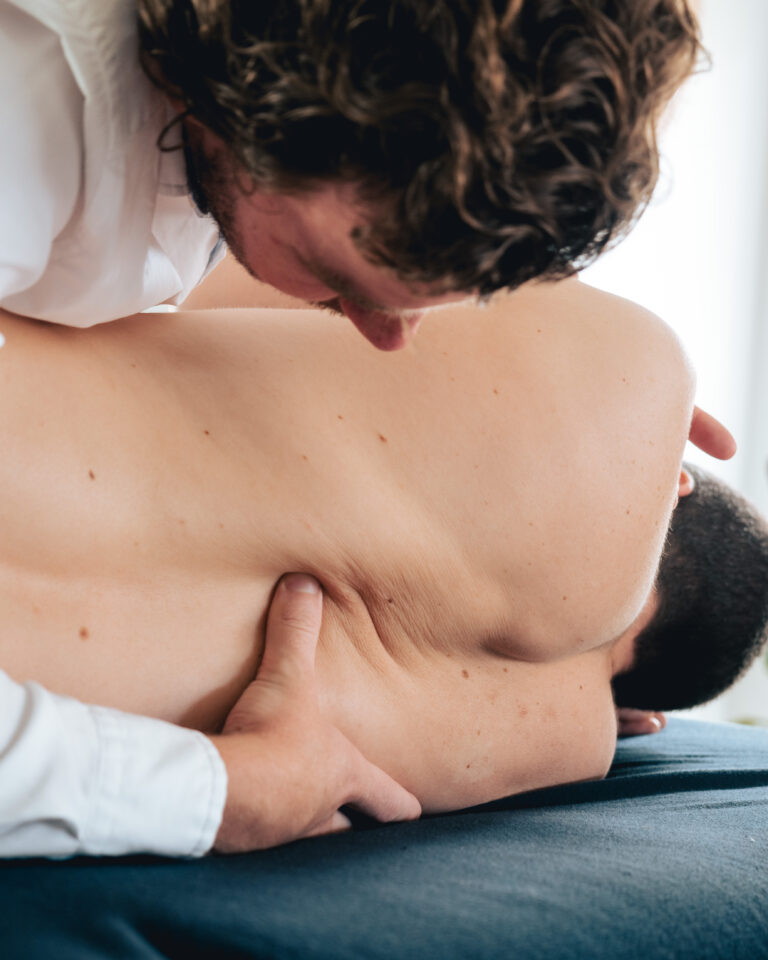
Physiotherapist treating a client's upper back beside the shoulder blade
Physiotherapist releasing the muscles around a client's shoulder blade

Preventing shoulder pain

If we could just get rid of shoulder pain, the world would be a much better place, right? So how can you help reduce your risk profile for suffering either an acute shoulder injury or developing a more slow developing onset of shoulder pain?

I would have to say that shoulder strength is your number one priority. I think the isolated internal and external rotation exercises that everyone does are a little overplayed. They can be great as a warm-up to get the rotator cuff firing, but we need to be doing a little more than that in the long term. I think of shoulder strengthening from the perspective of we need to strengthen the shoulder to do what it does in the real world. So we need it to:

Lift above head
Carry
Rotate
Lift and rotate
Carry overhead
Reach behind our back/head

We need to practice and improve the capacity to perform these movements and functions if we truly want to work towards reducing our risk profile for shoulder pain. Getting in the gym is a great option, but some people don’t have the time or they don’t enjoy it, so why not get around the house and do some of those jobs your spouse has been wanting you to do? Being active and using your shoulder will help develop its tolerance. Just don’t go doing too much too soon.

The shoulder is pretty darn complex even without considering how we need to integrate the rest of the body into a lot of the movements. Consider a tennis serve. It seems very shoulder dominant, but if you took away the actions from the rest of the body, athletes would lose a vast amount of power on their serve. So preventing shoulder pain in the athlete isn’t just about the shoulder. Athletes should consider their sport and what they need to perform. Shoulder health in athletes often relies on thoracic and lumbar mobility, hip strength and power output, shoulder strength and endurance, and even to the calves if we are looking at a tennis serve. Keep your entire body in check to help reduce your risk of shoulder pain or a shoulder injury if you are an athlete.

Shoulder Pain FAQs

Rotator cuff tendinopathy and minor strains often improve a lot over 6 to 12 weeks of targeted strengthening. Partial tears can take 3 to 6 months. If surgery is needed to repair a full tear, recovery commonly takes 6 to 12 months.

Not usually. Most shoulder pain can be diagnosed with a thorough assessment. I may suggest you speak with your GP about an ultrasound or MRI if you have had a significant injury such as a fall onto an outstretched arm, if there is marked weakness, or if your shoulder is not responding to treatment as expected.

Yes, within comfortable limits. Resting your shoulder completely can lead to stiffness and weakness. I will show you which movements to modify for now and give you exercises that keep it moving while gradually rebuilding strength.

Most shoulder problems respond well to physio without surgery. Surgery is usually considered for full thickness rotator cuff tears in younger or active people, repeated dislocations, or when a good period of rehab has not helped. If I think a surgical opinion is worthwhile, I will let you know and write to your GP.

Each consultation is 45 minutes and costs $110, for both your first appointment and follow-ups. Dry needling, taping and exercise bands are included at no extra cost. If you need a longer course of rehab, my 3, 6 and 12 week rehabilitation programs work out cheaper than paying per session.

Yes. You can claim a rebate from your health fund for every session. PRP Physio is not a preferred provider for any fund, so your rebate may be slightly smaller than at a preferred provider. Your fund can confirm the exact amount using item code 500 for your first consultation and 505 for follow-ups.

Yes, if your shoulder was injured at work, such as from lifting, a fall or repetitive overhead work. Your GP starts the claim and gives you a WorkCover certificate, which acts as your referral. Once your claim is accepted, I bill WorkCover directly, so there are no out-of-pocket costs for you. WorkCover covers your first five sessions, and I speak with your case manager if you need more.

Mobile Physio: Get in Touch

I'm ready to book online now

For those who are ready to book an appointment right now, let's get started on your journey back to sport!

Just hit the button below and it will take you straight to an online booking platform. You will just have to enter a few details and it will all be booked in for you!

I'd rather have a conversation first

Some injuries are complex, should you see a GP first, should you go get a scan, is a physio even the right person to see? Sometimes a 10 minute conversation can be enough to answer some of these questions.

Just submit a contact form on the link below and I'll give you a call ASAP and we can chat through a few things to get you moving in the right direction!
© 2026 PRP Physio. All rights reserved.