PRP Physio logo

Back Pain Physiotherapy Brisbane

Back Pain Rehabilitation

Low back pain is the most common musculoskeletal complaint presenting to GPs in Australia. Research predicts it will affect between one in seven and one in four Australians in their lifetime and between 10-40% of those will develop ongoing symptoms. Back pain prevalence is more widespread in western and developed nations and the rate of people developing ongoing concerns is only increasing. Persistent low back pain can be one of the most frustrating presentations for clients to present with. It affects nearly every aspect of their daily lives and reduces their ability to take part in the aspects of their life that they love.

Back pain can cause a range of functional difficulties going from difficulty sitting down for prolonged times, stiffness waking up in the morning, difficulty getting to sleep or even just staying asleep, to probably the most common difficulty, bending down and picking things up. These things are integral parts of daily life. If someone has difficulty, simply lifting things from the ground for several years that not only leads to physical effects but can also slowly erode someone’s confidence in their back.

I’ve never experienced back pain before, but the stats say it is pretty likely that I will in my life. While I haven’t experienced it firsthand, I have seen the effects that it can have on clients’ lives, taking someone from incredibly active one day to bedridden the next. In my experience as a physiotherapist, I have been able to treat many clients with back pain of an acute and chronic nature and improve their quality of life and maximise their outcomes. You can read more in my article on what causes lower back pain.
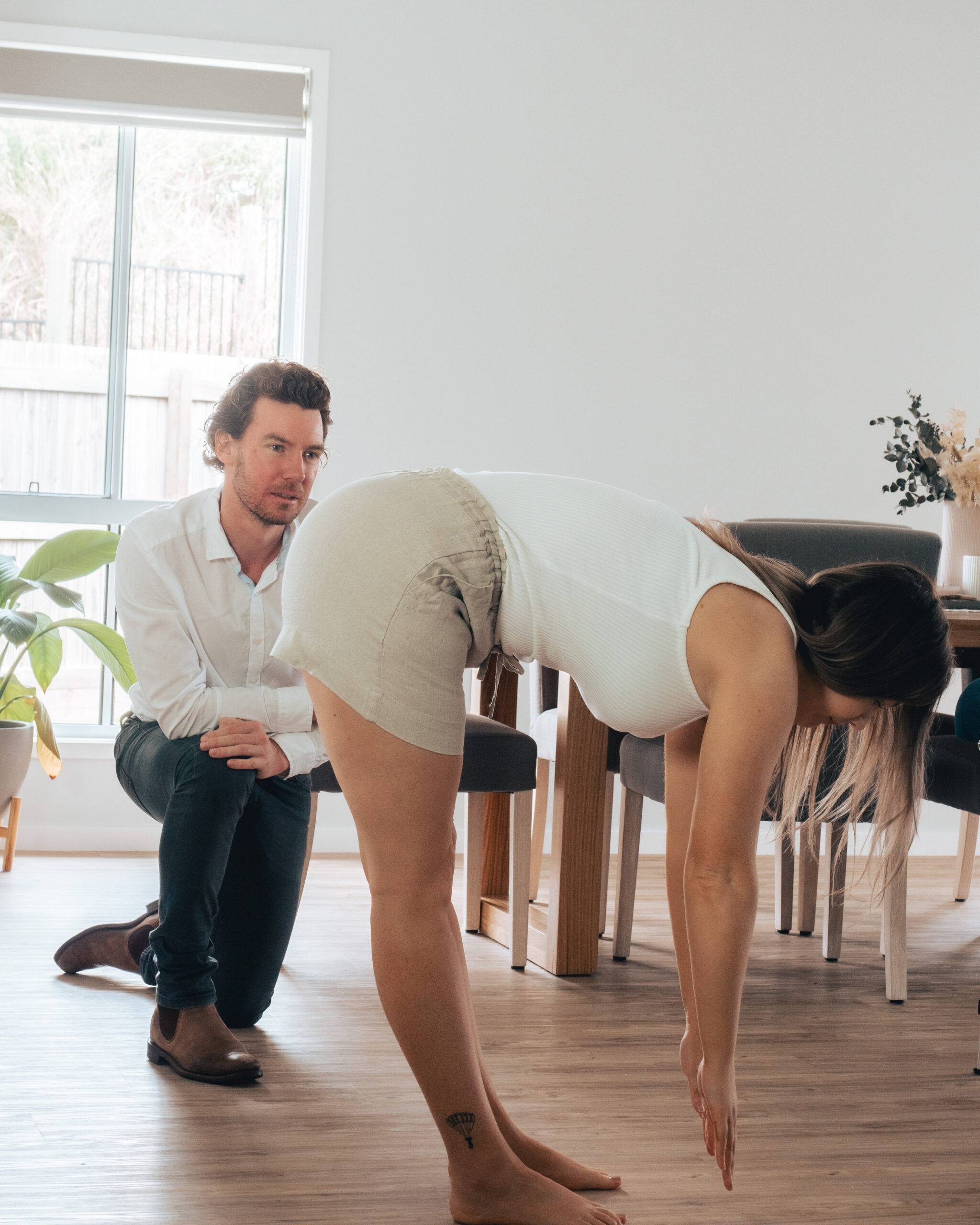
Physiotherapist assessing a client's lower back as she bends forward

The anatomy of the back

The lumbar facet joints are synovial joints that are between the superior and inferior articular processes of adjacent vertebrae in the lumbar spine. The superior articular process of one vertebra articulates with the inferior articular process of the vertebra above it. The facet joints are between the pedicle and lamina of the same vertebra and form the articular pillars that act to provide structural stability to the vertebral column.

The articulating surfaces of the facet joints are covered with hyaline cartilage, which helps to reduce friction and wear and tear on the joints. The joint capsule is a thin layer of tissue that surrounds the joint and helps to keep it in place. Nerves from the medial branches of the dorsal rami, which provide sensation to the joints, also allow them to move.

The lumbar facet joints allow for a variety of movements in the lumbar spine, including flexion, extension, lateral flexion, and rotation. They also help to stabilize the lumbar spine and prevent excessive movement.

Here are some additional details about the anatomy of the lumbar facet joints:

The lumbar facet joints are in the posterior portion of the lumbar spine, between the L1 and L5 vertebrae.

The articulating surfaces of the facet joints are angled to allow for flexion, extension, lateral flexion, and rotation of the lumbar spine.

Nerves from the medial branches of the dorsal rami, which provide sensation to the joints and allow them to move innervated the facet joints.

Ligaments, which help to stabilize the joints and prevent them from moving too far, also surrounded the facet joints.

The lumbar facet joints are important for allowing us to move our backs. They are also important for protecting the spinal cord, which passes through the lumbar spine.
Anatomy illustration of the lumbar vertebrae from several angles

The musculature surrounding the lumbar spine is divided into three layers:

Superficial layer: This layer comprises the erector spinae muscle, the quadratus lumborum muscle, and the latissimus dorsi muscle.
Intermediate layer: This layer comprises the interspinales muscles, the intertransversarii muscles, and the rotatores muscles.
Deep layer: This layer comprises the multifidus muscle, the semispinalis muscles, and the iliocostalis muscles.

The muscles of the lumbar spine work together to support the spine, flex and extend the spine, rotate the spine, and laterally flex the spine.

Here is a more detailed description of each layer of muscles:

Superficial layer:
Erector spinae muscle: This is the largest muscle in the back. It comprises three columns of muscles: the spinalis, the longissimus, and the iliocostalis muscles. The erector spinae muscle extends the spine and helps to maintain posture.
Quadratus lumborum muscle: This muscle is on the side of the lower back. It helps to flex and laterally flex the spine.
Latissimus dorsi muscle: This muscle is on the back of the torso. It helps to extend and laterally flex the spine.

Intermediate layer:
Interspinales muscles: These muscles connect the spinous processes of adjacent vertebrae. They help to extend the spine.
Intertransversarii muscles: These muscles connect the transverse processes of adjacent vertebrae. They help to laterally flex the spine.
Rotatores muscles: These muscles are located deep to the interspinales and intertransversarii muscles. They help to rotate the spine.

Deep layer:
Multifidus muscle: This muscle is the largest muscle in the deep layer. It is on the side of the spine. It helps to extend, rotate, and laterally flex the spine.
Semispinalis muscles: These muscles are on the back of the spine. They help to extend and rotate the spine.
Iliocostalis muscles: These muscles are on the side of the spine. They help to extend and laterally flex the spine.
Diagram of the deep muscles of the back, including multifidus and the erector spinae

The discs and nerve roots in the lumbar spine are closely related structures. The discs are the cushions that sit between the vertebrae, and the nerve roots are the nerves that branch off of the spinal cord and exit the spine.

The lumbar spine has five discs, one between each of the five vertebrae. The discs comprise a tough outer layer called the annulus fibrosus and a soft inner layer called the nucleus pulposus. The annulus fibrosus comprises concentric rings of collagen fibres, and the nucleus pulposus comprises a jelly-like substance.

The nerve roots in the lumbar spine exit the spinal cord through openings in the vertebrae called intervertebral foramina. There are five nerve roots in the lumbar spine, one for each of the five lumbar vertebrae. The nerve roots then travel down the spine and into the legs, where they provide sensation and movement to the lower extremities.

The discs and nerve roots in the lumbar spine are important for allowing for movement and flexibility in the spine. They also provide cushioning and support for the spinal cord.
Anatomy of the lumbar spine showing the vertebrae, discs and nerves

Back Pain Subjective Assessment

Back pain is complex. I’d be lying if I told you I had back pain solved. Anyone would be lying to you. We don’t know everything about back pain. Coming to conclusive structural diagnoses is difficult. I diagnose back pain within a pattern model. Does your back pain present as more joint driven, muscular driven, disc driven, or neurally driven? Once I can simplify this system, together we can better come to a working diagnosis and treatment pathway. It may not be the specific “L4-5 disc bulge” diagnosis that an MRI or CT scan could conclude, but honestly they are far from being accurate or clinically useful because of the vast number of asymptomatic people who have those findings on a scan. Clinical correlation with scan findings is vital, you are not your scan.

What Happened?

A detailed history of how your symptoms began and how they have progressed since the onset is where we often begin. Gaining an understanding of the days or weeks leading up to the onset as well as what triggered the pain are our starting points. From there, I like to know how the symptoms have changed and how they are affecting your day-to-day life and functional capacity, particularly what activities make your pain worse. Often I find clients can determine specific patterns or movement that aggravate their symptoms, for example, a common pattern that clients down like is flexion based activities such as picking things up from the floor, getting to and from bed, going from sitting to standing. These movement patterns can give me vital hints to what the cause of your back pain could be.

Any Other Sensations?

If you have any neural symptoms such as pins and needles, tingling, numbness or altered sensation, or feelings of weakness this could be a potential sign of nervous system involvement. Gaining an understanding of where these symptoms are and what triggers them is incredibly helpful to me as a clinician. Often these types of sensations will present as referred pain, or they will travel down the leg. Noting where you specifically feel these sensations is valuable to me. For example, if you can determine you are only feeling pins and needles on the outer side of your calf and down the outside of your foot that can provide information to me what nerve might cause your symptoms.

Your Beliefs about Back Pain

I know there is a bit of a trend of physiotherapists trying to be like psychologists but bear with me here. This isn’t a matter of me telling you the right and wrong beliefs, but recent evidence has found that there is often a link between avoidant behaviours and progression of acute back pain towards becoming persistent. Often, negative beliefs drive this within clients. It’s always important to remember that your back is a strong and stable structure, a disc doesn’t decide to suddenly “pop out”. You have bent and lifted things for years. Now is not the time to develop and suddenly change your movement patterns. I recall having a client a year ago who had an ongoing fear of setting off his back pain to the point it had significantly negatively affected his quality of life with his children. Changing his mindset and allowing himself to move and bend his back has allowed him to move freely and improve his quality of life, reduce his likelihood of back pain, and is back riding scooters with his kids.

Injury History

If you have had a previous history of lower back pain before, whether that be one acute episode or four episodes per year I’d like to know what has set them off previously and how you have managed them. If you have undertaken physio and it has worked well that’s awesome, let me know what you feel worked best. If you’ve seen physios in the past and haven’t found it worked that’s awesome, let me know what didn’t work and we probably won’t look down that pathway again. With that also comes what you did, what was the exercise program and did you complete it? Rehabilitation is a team journey that we need to embark on together to get the best result. You can read more in my article on how lower back pain is diagnosed.

Back Pain Objective Assessment

Whilst I don’t believe as physiotherapists we can often conclusively determine a specific structure that is causing your symptoms in the vast majority of cases. This doesn’t mean that I skimp on a thorough objective assessment to be as accurate and targeted as possible in your treatment plan. Through a targeted assessment, we can develop an individualised and targeted hands on treatment plan and exercise program to get you moving and back to full function as fast as possible.

Range of Motion

Often the first thing I and almost all physios will assess is the movement of your lower back. For most clients, bending forwards is the most aggravating movement, but for some, it may be an extension or side bending movement. I like for clients to talk me through what they feel as they go, whether it be a tightness sensation or a pulling or grabbing sensation. These little details are important, and I like to know how you are going with them. The more specific you can be with the location of these symptoms, the better. During this portion of the assessment, you may feel some referral pain down your legs. It’s important that you report that to me if you do. I may perform a mini test where I can assess a repeated manoeuvre, often in the opposite direction. Most times, clients will feel this referral pain bending forwards, so I may test repeated back extensions to see if this eases your symptoms when you bend forward.

Neural System Assessments

Specific assessments I will perform to help me narrow down the diagnosis to get as specific as possible will often potentially include an assessment of neural structures. This can be done in the form of a neurological assessment where I will assess your sensation, strength, and reflexes. The other way I may assess it is through neurodynamic tests. Essentially this is where I will assess the mobility of the neural system to look for any areas of restriction that may be causing neural referral. There may be other specific assessments such as testing for SIJ involvement, the inclusion of these is based on your subjective findings and whether we believe that this may be a potential cause of symptoms.

Palpation

Palpation of the lumbar spine itself is often one of the most important pieces of the assessment. This includes both palpation of the muscles assessing for spasm, tenderness to touch, and muscle tone, as well as assessment of the spinal facet joints assessing for both tenderness to touch and for stiffness. Some clients may report referral symptoms during this portion of the assessment. If you could please mention this to me, as it could be clinically significant. Often I will assess both the lumbar spine and the areas surrounding it. This is likely to include the thoracic spine and both the anterior and posterior of the hip.

Functional Assessment

A functional assessment should form part of any assessment, let alone a client presenting with low back pain. It will depend highly upon how irritable your symptoms are, as well as what is functional for you both in terms of what you do on a day-to-day basis, and what aggravates your symptoms. But often it will include looking at you walking, squatting, or bending to pick something up, or if you are under WorkCover we could look at work-specific movement patterns. I am often looking for both symptom production and both your movement efficiency and movement patterns to determine any factors that may have predisposed you to your injury.

Steps to Success for Recovering from Low Back Pain

Hands On Treatment

Good quality, hands-on treatment appears to be becoming a thing of the past from what I hear. I find this unfortunate because it should be our bread and butter as physiotherapists and it can have amazing results. Most work will often be done around the hips and lower back to reduce muscular tension and improving freedom of movement. Most of the hands-on work we will do will be a massage or soft tissue release techniques such as trigger point release or joint mobilisations. The combination of these two treatment techniques combined can reduce symptoms and improve your functional capacity.

In most acute cases of low back pain, I find taping techniques can provide significant lasting effects to reduce the muscle spasm and tightness that occurs and often drives the symptom irritability. It’s important that you let me know if you have any history of taping reactions such as blistering, skin redness, or itchiness, as this may mean that we may not utilise the same type of tape. I will always ask before putting the tape on, but if you have any issues with a skin reaction, always remove the tape immediately.
Physiotherapist treating a client's lower back and hip while they lie on their side

Exercise for Low Back Pain

Everyone usually loves the hands-on treatment side of things that physios do, the exercise programs though, not so much. I totally get it. Exercises often aren’t that fun. Some of them you look a little strange doing, but trust me, they work. Manual therapy techniques are a short-lasting treatment effect. They aren’t designed to get you better and feel better forever. And they certainly aren’t designed to prevent future injuries. Alas, this is where a home program comes in. A comprehensive and individualised exercise program that develops towards an ongoing injury prevention program is the gold standard treatment for managing an injury and preventing future recurrence.

Back pain exercise programs should ideally include both strengthening of specific muscles that we have targeted within our objective assessment, along with a program to improve your mobility. This could take the form of utilising trigger point balls or foam rollers, or beginning a stretching program.

What I don’t want you to take this as is to get into the gym and stay in the gym. Personally, I don’t really like the gym, so if someone gave me a gym program, I wouldn’t be too enthused. I aim to work with you to find the type of exercise that you enjoy and want to do. We should work to develop a lifelong habit rather than a two-month boot camp you don’t enjoy. Specifically, regarding back pain, there could be options such as Tai Chi, Yoga, or Pilates, there is a good enough base of evidence that these forms of exercise are effective at maintaining mobility and can be utilised in back pain management.

Related reading: My Top 5 Exercises for Low Back Pain and My Top 5 Stretches for Low Back Pain, both with follow-along videos.

Physiotherapist assessing a client's lower back and hip movement as she lifts one knee

Your Questions About Back Pain

What causes lower back pain?

Most lower back pain is what clinicians call non-specific low back pain. That means a clear single structure cannot be identified, and it does not mean nothing is wrong. Pain usually comes from a combination of irritated joints, muscles and discs, often triggered by a change in load such as lifting, gardening, a long drive or a new training program. Sleep, stress and general fitness also influence how sensitive your back is. A small number of cases involve a nerve, a fracture or another medical cause, which is why my assessment screens for these first.

What exercises help lower back pain at home?

Walking is one of the best things you can do, starting with short, regular walks and building up. Gentle movement exercises like knee rocks while lying on your back, cat and camel on your hands and knees, and pelvic tilts can ease stiffness. As your pain settles, strengthening exercises such as bridges, bird dogs, side planks and squats help your back handle everyday load. The best exercises depend on what eases or aggravates your pain, so I will tailor a program for you rather than a one-size-fits-all routine. If you'd like somewhere to start, my top 5 stretches for low back pain include videos you can follow at home.

Can I keep working with back pain?

For most people, yes, and staying at work often helps recovery. Research shows people who keep working with modified duties tend to recover faster than those who take extended time off. You may need some changes for a while, such as breaking up long periods of sitting, avoiding heavy lifting or swapping tasks with a colleague. If your job is physically demanding, I can help plan a gradual return to full duties and provide information for your employer, GP or WorkCover case manager.

Why does my back pain keep coming back?

Recurrent back pain is very common, and a flare does not usually mean you have done new damage. Common reasons include returning to full activity too quickly, losing strength and fitness after the pain settles, big spikes in workload, poor sleep and stress. The best protection is staying active and keeping up regular strength exercise once your pain has gone, rather than stopping your program as soon as you feel better. I also help you build a plan for managing flare-ups, so a bad day does not turn into a bad few weeks.

Will I need surgery for back pain?

Very few people with back pain need surgery. Most episodes improve with time, staying active and exercise-based rehab. Surgery is generally considered when there is a clear structural problem causing significant or worsening nerve symptoms, such as increasing leg weakness, or severe pain that has not responded to several months of good conservative care. Loss of bladder or bowel control, or numbness in the groin area, is a medical emergency. If I think a review with your GP or a surgeon is worthwhile, I will let you know.

Should you get a scan?

For most cases of low back pain, imaging such as MRI or CT scans is unnecessary. Recent research has identified that most of the findings within an MRI or a CT of the lumbar spine are highly prevalent within an asymptomatic population. I have lost count of the number of clients I have seen with back pain who have a clean MRI, or people with minimal to no back pain who have multiple findings on a scan.

The most important aspect to always take into consideration if you choose to go for imaging, is that you need either an experienced GP or a physiotherapist to clinically reason whether the findings apply to you and your presentation. This involves a thorough subjective and objective assessment, as I have detailed above.

I also ask my client to ask themselves one question, and that question is to consider what they will do with the information on the scan. If they don’t believe that they are likely to progress towards a specialist consultation, or if I don’t believe that the information will alter the treatment pathway, the clinical utility of the scan is often minimal.

Back Pain FAQs

Most episodes of acute lower back pain improve a lot within 2 to 6 weeks, and many people feel much better within the first couple of weeks. Pain that has lasted longer than 3 months is considered persistent and usually needs a longer, more structured program. After your first assessment I can give you a realistic timeframe for your situation.

Keep moving within comfortable limits. Bed rest used to be the standard advice, but we now know it slows recovery. Gentle walking and your normal daily activities, adjusted where needed, help your back recover faster, and I will show you which movements to modify in the meantime.

Most back pain is not caused by anything serious. Seek urgent medical attention if your back pain comes with loss of bladder or bowel control, numbness around the groin or genitals, weakness in your legs that is getting worse, fever or unexplained weight loss, or if it started after a major fall or accident.

Each consultation is 45 minutes and costs $110, for both your first appointment and follow-ups. Dry needling, taping and exercise bands are included at no extra cost. If you need a longer course of rehab, my 3, 6 and 12 week rehabilitation programs work out cheaper than paying per session.

Yes. You can claim a rebate from your health fund for every session. PRP Physio is not a preferred provider for any fund, so your rebate may be slightly smaller than at a preferred provider. Your fund can confirm the exact amount using item code 500 for your first consultation and 505 for follow-ups.

Yes, if your back pain was caused by your work, such as a lifting injury or a strain from repetitive tasks. Your GP starts the claim and gives you a WorkCover certificate, which acts as your referral. Once your claim is accepted, I bill WorkCover directly, so there are no out-of-pocket costs for you. WorkCover covers your first five sessions, and I speak with your case manager if you need more.

Yes. Back pain is a common injury after a car accident, even a low speed one. If you have been injured in a motor vehicle accident, the cost of your physio is usually covered by the third party insurer of the vehicle at fault. See your GP as soon as you can after the accident so your injuries are documented and your GP can refer you for physio. Most insurers cover your first consultation, and I then send the insurer a treatment plan outlining my findings, your goals and how many sessions I recommend. I bill the insurer directly, so there are no out-of-pocket costs for approved claims.

Mobile Physio: Get in Touch

I'm ready to book online now

For those who are ready to book an appointment right now, let's get started on your journey back to sport!

Just hit the button below and it will take you straight to an online booking platform. You will just have to enter a few details and it will all be booked in for you!

I'd rather have a conversation first

Some injuries are complex, should you see a GP first, should you go get a scan, is a physio even the right person to see? Sometimes a 10 minute conversation can be enough to answer some of these questions.

Just submit a contact form on the link below and I'll give you a call ASAP and we can chat through a few things to get you moving in the right direction!
© 2026 PRP Physio. All rights reserved.