PRP Physio logo

Fracture Rehabilitation Physiotherapy

Fracture Management and Rehabilitation

A fracture diagnosis tends to stop people in their tracks. There's an assumption that comes with it, and that is that you'll be immobile for months, that the affected area will never quite be the same, that rehabilitation is a case of simply waiting for the bone to heal before doing anything. None of that is quite right, and it's one of the areas of practice where good physiotherapy input from an early stage can genuinely change outcomes.

Bone is a living, adaptive tissue, not unlike a ligament or a muscle, and it responds to appropriate loading in much the same way. Left completely immobile and nonweightbearing for too long, surrounding muscles weaken, joints stiffen, and the eventual return to full function takes considerably longer than it needs to. Managed well, with the right balance of protection in the early stages and progressive loading as healing allows, most fractures can be rehabilitated back to full function without lasting deficit.

I work closely alongside your treating doctor or orthopaedic surgeon throughout this process, respecting the specific healing timeframes and precautions or restrictions they advise are relevant to your fracture and recovery process while making sure that everything else including your strength, mobility, and confidence, isn't left to simply switch back on once a cast or boot comes off.
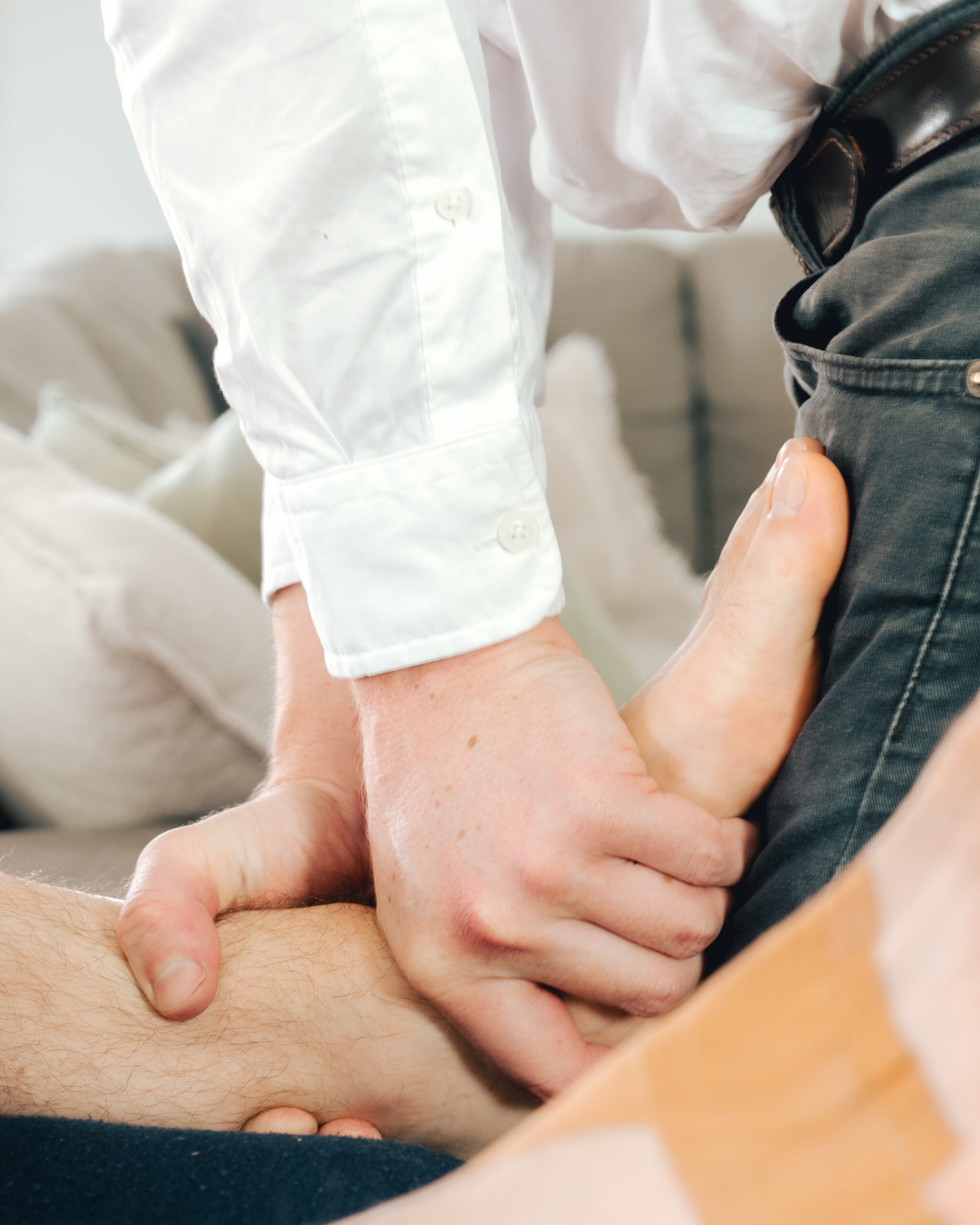
A sports physio is putting a bandage on his foot.

The biology of bone healing

Bone is composed of two main types of tissue: dense cortical bone, which forms the strong outer shell, and spongier cancellous bone, found particularly at the ends of long bones, which provides structural support while remaining relatively lightweight. Both types of bone are living tissue, supplied by blood vessels and constantly remodelling in response to the loads placed upon them.
Anatomy of a bone

Fracture healing generally progresses through three overlapping stages. The inflammatory stage begins immediately after injury, as the body forms a blood clot at the fracture site and begins recruiting the cells needed for repair. This is typically followed by the reparative stage, where a soft callus of cartilage and early bone forms to bridge the fracture, gradually hardening into a firmer bony callus over several weeks. Finally, the remodelling stage sees this bony callus gradually reshaped and strengthened over months, guided in large part by the mechanical loads placed on the bone during this period.
A physiotherapy diagram illustrating the different parts of a bone.

A key principle underlying fracture rehabilitation is Wolff's Law, which describes how bone adapts and strengthens in response to the loads placed upon it. This is precisely why appropriate, graded loading during rehabilitation is so important; a bone that's protected indefinitely doesn't just fail to strengthen, it can lose density and resilience compared to one that's exposed to progressive, sensible loading during recovery.

Fracture Subjective Assessment

Gaining an understanding of what has happened between the time of your injury and coming to see me is of paramount importance. If you haven't been assessed or diagnosed and we are suspecting a fracture we need to determine the correct imaging pathways to go down. If you have already had imaging and have a confirmed fracture, I will want to understand who you have already seen and what management pathways are already underway.

What Happened?

Understanding the mechanism of your fracture, whether it was a high-impact trauma such as a fall from height or a sporting collision, or a lower-impact injury that may point towards other contributing factors such as reduced bone density, helps inform both my assessment and my expectations around healing.

Diagnosis and Management so far

I'll want to know the specific diagnosis provided by your doctor or surgeon, whether the fracture was managed surgically or conservatively, and what precautions or weight-bearing restrictions have been advised, since these details directly shape what I can and can't do with you at this stage.

Current Symptoms and Functional Level

I'll ask about your current pain levels, any swelling, and how the injury is affecting your daily activities, sleep, and if relevant, your ability to work or train, to build a clear picture of where you're starting from.

Goals for Rehabilitation

As with any rehabilitation program, understanding what you want to return to, whether that's a specific sport, a physically demanding job, or simply pain-free daily function, helps me tailor your program towards outcomes that actually matter to you.

Fracture Objective Assessment

Following being diagnosed with a fracture, our objective assessment becomes all about determining what we need to be working on to maintain as much function, mobility and strength surrounding the fracture site. A thorough assessment of each of the surrounding areas that contribute to the kinetic chain is vital.

Observation and Swelling

I'll assess the affected area for swelling, bruising, and any visible changes in alignment, comparing where relevant to the uninjured side, and monitor how these change over the course of your recovery.

Range of Motion

Depending on the stage of healing and any precautions in place, I'll assess the available movement in joints above and below the fracture site, since these are commonly affected by a period of immobilisation even when the fracture itself is progressing well.

Weightbearing and Functional Status

Where relevant, I'll assess your current weight-bearing status and functional capacity, including your ability to walk, use crutches or other aids appropriately, and perform relevant daily tasks safely within your current precautions.

Strength Assessment

I'll assess the strength of the surrounding musculature, both to establish a baseline and to identify areas that are likely to have weakened during any period of immobilisation, which will guide the early stages of your strengthening program.

Healing Timeframes and Staged Rehabilitation

The Protection Phase

In the early weeks following a fracture, the priority is respecting the healing timeframes and precautions set by your treating doctor or surgeon, while managing swelling and maintaining the strength and mobility of unaffected areas as much as possible. This phase might include gentle range of motion for adjacent joints, isometric exercises where appropriate, and education around safe movement within your current restrictions.

The Progressive Loading Phase

As healing progresses and precautions are gradually lifted, the emphasis shifts towards restoring range of motion at the affected joint, rebuilding strength that has been lost during immobilisation, and gradually reintroducing functional loading in line with the stage of bone healing and your surgeon's guidance.
A woman receiving sports physiotherapy for her leg.

The Return to Function Phase

In the final stage, the focus turns to higher-level strengthening, restoring full range of motion, and where relevant, a graduated return to sport or physically demanding work, ensuring the area can tolerate the specific demands you're aiming to return to before you get there.

Do I Need Physio If I'm Still in a Cast or Boot?

Yes, and this is one of the most common misconceptions I come across. Even while a fracture is immobilised, there is almost always something productive we can be doing, whether that's maintaining movement and strength in joints above and below the injury, managing swelling, or simply making sure you're moving safely and confidently on crutches. Starting rehabilitation early, within whatever restrictions are appropriate, consistently leads to a faster and more complete recovery once the fracture has healed enough to begin more active loading.
A man receiving sports physiotherapy from a physiotherapist.

Your Questions About Fractures

Do I need physio after a fracture?

Not everyone does, but many people benefit. After weeks in a cast, boot or sling, it is common to have stiff joints, weaker muscles, swelling and reduced confidence. Physio helps restore movement and strength, gets you back to work, sport and daily life safely, and checks that recovery is on track. It is particularly useful after fractures around joints like the wrist, ankle and shoulder, after surgery to fix a fracture, and for anyone returning to sport or physical work.

What should I do when my cast or boot comes off?

Expect your limb to feel stiff, weak and a little strange at first, and the skin may be dry and flaky. Start with gentle movement exercises a few times a day, and follow your doctor's advice on how much weight you can put through it. Swelling often increases for a while once you are moving more, so elevation helps. Avoid jumping straight back into heavy lifting or sport. This is the ideal time to start physio, so we can build movement and strength back in a structured way.

Why is my joint so stiff after a fracture?

Joints that have been kept still for several weeks become stiff as the surrounding capsule, ligaments and muscles tighten. Swelling and pain also limit movement, and fractures close to or into a joint tend to cause more stiffness. The good news is that most stiffness improves with regular movement exercises, hands-on treatment and time. Starting early, once your doctor allows, makes a big difference, and some stiffness can take several months to fully resolve.

What are the signs of a stress fracture?

Stress fractures usually develop gradually rather than from a single injury. Common signs include pain in a specific spot on a bone that gets worse with activity, especially running or jumping, pain that starts earlier in each session, and pain that lingers after activity or appears at rest or at night. The bone is often tender to touch. They are most common in the shin, foot and hip, and often follow a sudden increase in training. If a stress fracture is suspected, it is important to reduce load and get imaging organised.

Fracture FAQs

Most fractures in adults take around 6 to 8 weeks for the bone to heal enough to start loading, depending on the bone and the type of fracture. Getting back your full strength and movement often takes 3 to 6 months. Children usually heal faster, while older adults and smokers tend to heal more slowly.

Once your doctor confirms the bone has healed and you have rebuilt your strength, movement and confidence. For many fractures this is around 3 to 4 months after the injury, and contact sports can take longer.

It is a common belief, but not quite. The healing bone forms a thicker area at first, then remodels over the following months back towards its normal shape and strength. What we can do is make sure the muscles and joints around it are strong, so the whole area is ready for what you want to do.

Each consultation is 45 minutes and costs $110, for both your first appointment and follow-ups. Dry needling, taping and exercise bands are included at no extra cost. If you need a longer course of rehab, my 3, 6 and 12 week rehabilitation programs work out cheaper than paying per session.

Yes. You can claim a rebate from your health fund for every session. PRP Physio is not a preferred provider for any fund, so your rebate may be slightly smaller than at a preferred provider. Your fund can confirm the exact amount using item code 500 for your first consultation and 505 for follow-ups.

Yes, if you broke the bone in a work accident. Your GP starts the claim and gives you a WorkCover certificate, which acts as your referral. Once your claim is accepted, I bill WorkCover directly, so there are no out-of-pocket costs for you. WorkCover covers your first five sessions, and I speak with your case manager if you need more.

Mobile Physio: Get in Touch

I'm ready to book online now

For those who are ready to book an appointment right now, let's get started on your journey back to sport!

Just hit the button below and it will take you straight to an online booking platform. You will just have to enter a few details and it will all be booked in for you!

I'd rather have a conversation first

Some injuries are complex, should you see a GP first, should you go get a scan, is a physio even the right person to see? Sometimes a 10 minute conversation can be enough to answer some of these questions.

Just submit a contact form on the link below and I'll give you a call ASAP and we can chat through a few things to get you moving in the right direction!
© 2026 PRP Physio. All rights reserved.